How Long Can You Use a Copyrighted Song on TikTok?
A popular song can make a TikTok feel more polished, but music rights are not as simple as counting down a few seconds. Many creators have heard that 10 or 30 seconds of a copyrighted song is automatically safe. That is not how copyright works.
TikTok’s music permissions depend on its licensing agreements, the type of account posting the video, where the music comes from, and where the finished video will appear.
For music selected directly from TikTok’s licensed in-app libraries, the commonly cited limit is up to 60 seconds. That limit comes from TikTok’s licensing arrangements with music rights holders rather than from a rule in U.S. copyright law. It also applies to music used within TikTok under the conditions attached to that library.
The distinction matters. A creator who uses 45 seconds of a song from TikTok’s approved library is in a different position from someone who uploads 45 seconds of the same song from an outside source. The length may be identical, but the licensing situation is not.
This guide explains TikTok’s 60-second music limit, the myths surrounding 10- and 30-second clips, differences between personal and business accounts, what can happen when music is flagged, and how independently licensed music works when content needs to appear on several platforms.
The 60-Second TikTok Music Limit
TikTok’s music rules often get reduced to a simple statement: “You can use 60 seconds of a song.” The actual rule needs more context.
The 60-second figure relates to music that TikTok has licensed for use through its own music libraries. When a creator selects an available track from the appropriate TikTok library, the platform has already arranged certain rights with labels, publishers, distributors, and other rights holders. Those agreements determine how the music can be used.
That permission does not mean TikTok gives every creator ownership of the song. Instead, TikTok provides access to music under the terms of its platform licenses.
For creators using licensed in-app music, the important points are:
1. The music should come from the appropriate TikTok library.
2. The permitted use depends on the account and library involved.
3. The commonly cited in-app limit is 60 seconds.
4. The permission applies to TikTok rather than automatically extending to other platforms.
5. Changing the music may create a separate rights issue.
The 60-second figure therefore should not be treated as a universal copyright threshold. It is a platform licensing condition.
A short clip imported from an outside source does not automatically become legal simply because it lasts less than one minute. A creator still needs permission or another valid legal basis for using that recording.
Where the 60-Second Limit Comes From
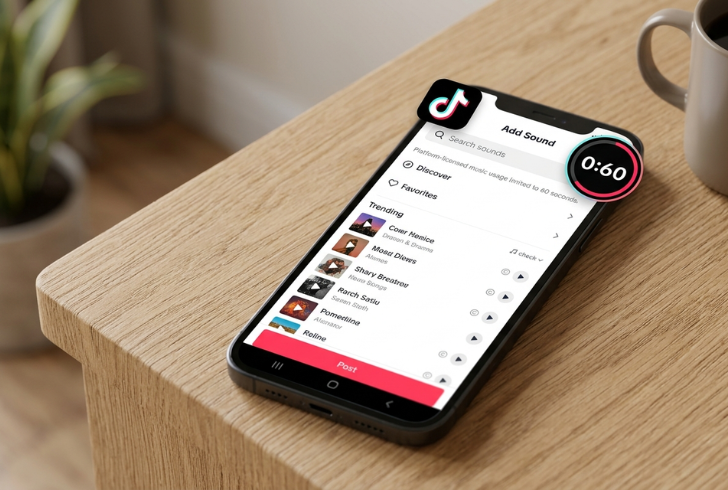
Gemini AI | TikTok’s 60-second song limit is set by its music licensing deals, not U.S. copyright law.
U.S. copyright law does not contain a general rule saying that people can use 60 seconds of a copyrighted song without permission. TikTok’s limit comes from licensing arrangements that govern how music can appear on the platform.
Music involves several layers of rights. A song may have rights in the underlying musical composition and separate rights in a particular sound recording. Different parties can control those rights, including songwriters, publishers, recording artists, labels, and distributors.
TikTok negotiates permissions with rights holders so users can access certain music through its platform. Those agreements can include restrictions involving duration, account type, commercial use, territory, and other conditions.
That is why a song can be available inside TikTok while remaining protected by copyright.
The distinction is simple:
TikTok having permission to offer a song does not mean every creator personally owns or controls that song.
The creator receives access under the platform’s rules. If the same recording is taken outside TikTok and posted somewhere else, a different license may be required.
This also explains why a clip can be permitted on TikTok but flagged on Instagram or YouTube. Each platform has its own relationships with music rights holders.
The 10-Second Rule Is Not a Copyright Rule
One of the most common claims online is that using fewer than 10 seconds of a song is automatically safe.
There is no general U.S. copyright rule that creates a 10-second exemption.
A creator can potentially face a copyright issue even when using only a very short portion of a recording. Copyright protection does not suddenly disappear when a clip reaches nine or ten seconds.
TikTok’s automated systems can identify recognizable music in short clips. The system does not simply wait until a particular number of seconds has passed before checking the audio.
The same principle applies to music imported from another source. A five-second clip may still contain recognizable protected material.
Duration can matter in a legal analysis, but it does not create an automatic permission.
What About the 30-Second Rule?
The 30-second rule is another widespread misconception.
There is no blanket rule under U.S. copyright law stating that 30 seconds of a song can always be used without permission. The same applies to 15 seconds, 20 seconds, or any other fixed duration.
Some informal discussions about music licensing, broadcasting, sampling, and fair use may have helped spread these numbers. However, they should not be confused with a universal legal safe harbor.
For TikTok creators, the practical question is not simply, “How long is the clip?”
The better questions are:
1. Where did the music come from?
2. Does the license cover TikTok?
3. Is the account personal or commercial?
4. Does the permission cover the intended use?
5. Will the same video be posted elsewhere?
Those factors provide a much clearer picture of whether the music can be used.
What Fair Use Actually Means
Fair use often appears in discussions about copyrighted music, but it does not create a simple time limit.
Under U.S. copyright law, fair use generally involves a case-by-case assessment of several factors. These include the purpose and character of the use, the nature of the copyrighted work, the amount used compared with the entire work, and the effect of the use on the market for the original.
That means a short clip is not automatically fair use.
The amount of music used can matter, but courts may also consider whether the selected portion represents an important or recognizable part of the work. A brief clip containing a song’s most distinctive section can raise different questions from an incidental, less significant portion.
Fair use also depends heavily on context. Commentary, criticism, parody, education, and other uses can raise different considerations from entertainment or promotional content.
Because fair use is fact-specific, creators should not treat a 10-second or 30-second clip as a guaranteed defense.
Personal Accounts and Music
Personal TikTok accounts generally have access to the platform’s broader General Music Library. This includes many popular songs and other tracks that TikTok has cleared for eligible uses.
When a creator selects a song directly from that library, the use falls under TikTok’s applicable music agreements and platform terms.
That does not mean the creator can take the same music and freely publish it on other services.
For example, a video may use a song through TikTok’s music picker and remain available on TikTok. If the creator downloads that video and uploads it to another platform, the second platform may assess the music under its own licensing arrangements.
The difference becomes especially important for creators who regularly repurpose short-form videos.
A TikTok music permission should be viewed as platform-specific permission, unless the applicable license clearly states otherwise.
Business Accounts Have Different Access
Business accounts face additional restrictions because commercial content has different licensing requirements.
TikTok’s Commercial Music Library is designed for business and promotional use. It contains tracks that are cleared for commercial activity under the applicable TikTok terms.
A song available to a personal account may not appear in the Commercial Music Library. That does not mean the song has no copyright protection. It means the available TikTok license may not cover commercial use by a business account.
For a company, agency, retailer, or other commercial operation, using a trending song from a personal creator’s library can create a rights problem if the track is not cleared for the intended promotional use.
Business accounts should therefore check the music source before publishing rather than assuming that every song visible on TikTok is available for commercial content.
What Happens When Music Exceeds the Limit?
A video that uses music outside the applicable license can trigger several forms of enforcement.
The most familiar result is a muted video. TikTok may remove the sound while leaving the visual content online. That can be particularly disruptive when music forms a major part of the video’s appeal.
Other outcomes can include restrictions, regional availability changes, or removal of the video. The response can depend on the rights holder’s instructions and the circumstances surrounding the detected material.
Repeated copyright violations can also create account-level consequences.
Automated audio recognition plays a major role in this process. Platforms use audio-matching systems to identify recordings that appear in uploaded content. The technology can recognize music even when a creator did not deliberately select the track through the platform’s music library.
A copyright flag does not always mean the creator intentionally violated someone’s rights. Mistakes can happen, especially when the creator has a valid license or owns the music. That is why documentation matters.
Can a TikTok Copyright Claim Be Appealed?
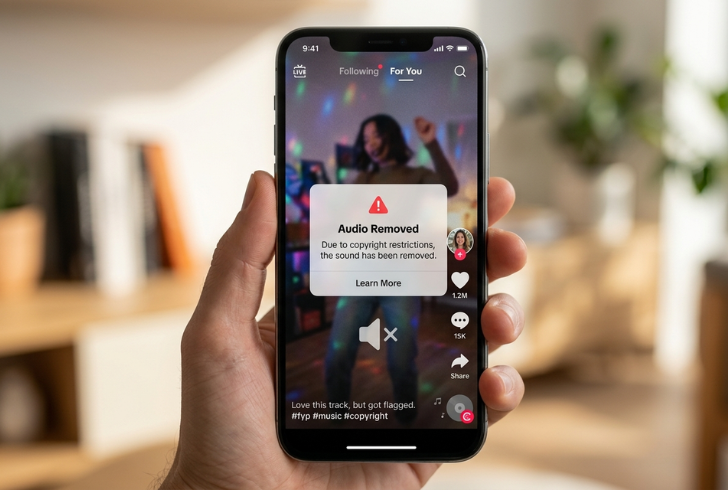
Gemini AI | If your music was wrongly restricted on TikTok, file a dispute through copyright reporting.
Creators who believe a music restriction was incorrect may have options to challenge the action through TikTok’s available copyright or content reporting procedures.
A strong appeal should be based on a real legal or licensing reason. Useful documentation can include proof of ownership, music license, distribution agreements, permission from the rights holder and evidence that the claimed audio does not match the protected work.
Simply stating that the clip is short is generally not enough to establish permission. If a creator owns the music or has secured the proper license, retaining the relevant paperwork can make a dispute easier to address.
TikTok Music Doesn’t Cover Other Platforms
Cross-posting creates one of the biggest copyright traps for short-form creators.
Suppose a creator produces a video on TikTok using a song selected from TikTok’s music library. The video plays normally on TikTok. The creator then downloads the video and posts the same file to Instagram Reels.
Instagram does not automatically inherit TikTok’s music license. The same principle applies to YouTube Shorts. YouTube evaluates uploaded audio through its own systems and licensing framework.
As a result, the same song can be permitted in one location and restricted in another. The key point is that music licensing follows the terms of the license, not the video file.
Saving a TikTok video does not carry TikTok’s music permissions into another platform.
Why Cross-Posting Can Trigger Claim
Each major platform has its own agreements with music companies and rights holders.
When a creator chooses a song inside TikTok, TikTok handles the relevant platform license. When the creator posts the same recording to another service, that service needs its own legal basis for the music.
This creates a common situation:
A video contains 30 or 60 seconds of a popular song. TikTok allows it. Instagram detects the recording and mutes the audio. The creator assumes the second platform made a mistake because the original TikTok was legal.
The issue may not be the video itself. The issue may be that the original permission never covered Instagram.
Creators who routinely publish on TikTok, Instagram, and YouTube should therefore secure music rights that specifically cover all intended platforms.
Using More Than 60 Seconds
Creators who need longer music have two basic options.
The first is to work within TikTok’s in-app music system and keep the licensed portion within the applicable limit. TikTok’s built-in trimming tools can help select a shorter section of a track.
The second option is to use music that has been independently licensed for the intended use.
The second approach becomes more relevant when a video requires a longer musical section, commercial usage, or publication across several platforms.
The license should clearly identify the permitted platforms and type of use. It should also address commercial activity if the video promotes a business, product, service, or sponsored partnership.
A creator should not assume that a track labeled “royalty-free” automatically covers every use. Royalty-free generally describes how payment works under a license. It does not necessarily mean the music has no copyright owner or that every use is unrestricted.
Adding Licensed Music Before Upload
Music can be added to a finished video through editing software before the file reaches TikTok.
Common editing tools include CapCut, iMovie, and Premiere Rush. The creator can place the properly licensed track into the video, export the completed file, and then upload that file to TikTok.
This method is different from selecting a song from TikTok’s own music library.
The important issue is not the editing software. The important issue is whether the creator actually has the necessary rights to use the music.
If the license allows TikTok, commercial use where applicable, and the desired duration, the creator can use the music according to those terms.
TikTok may still ask the uploader to confirm that the necessary music rights have been obtained. That confirmation should be treated as an attestation of actual rights, not as a replacement for a license.
Original Music Is Different
Creators who compose and record their own music generally have greater control over how the recording is used, provided they own the relevant rights.
However, ownership can become complicated when a track includes material created by someone else.
For example, recording a personal version of another artist’s song does not automatically transfer ownership of the underlying composition. The new recording and the original composition involve separate rights.
A cover version can therefore require permission even when the recording itself is completely new.
The same caution applies to samples, loops, sound effects, backing tracks, and production elements. A creator may own the final recording while still using components that carry separate restrictions.
Third-Party Music Licenses
Third-party music libraries can offer licenses designed for social media use. The quality of the license matters more than the label attached to the service.
Before using a track, check whether the agreement covers:
1. TikTok
2. Instagram
3. YouTube
4. Commercial content
5. Paid advertising
6. Brand partnerships
7. Full-length music use
8. Monetized videos
Terms can differ between services and subscription levels. Some licenses may cover organic social posts but exclude advertising. Others may permit personal use while restricting commercial projects.
The license should always be checked before publication.
A Practical Way to Avoid Music Problems
A simple workflow can reduce most avoidable music mistakes.
First, identify the account type. Personal and business accounts do not necessarily receive the same music options.
Next, identify the source of the music. A track selected from TikTok’s library follows TikTok’s licensing conditions. A track added externally requires separate permission.
Then consider where the video will appear. If the same file will go to Instagram and YouTube, TikTok-only music may not be sufficient.
Finally, check the license before publishing. Keep a copy of the license, receipt, or permission record when independently licensed music is involved.
This process takes less time than dealing with a muted video or a disputed copyright claim after publication.
Copyright-Safe Music Options
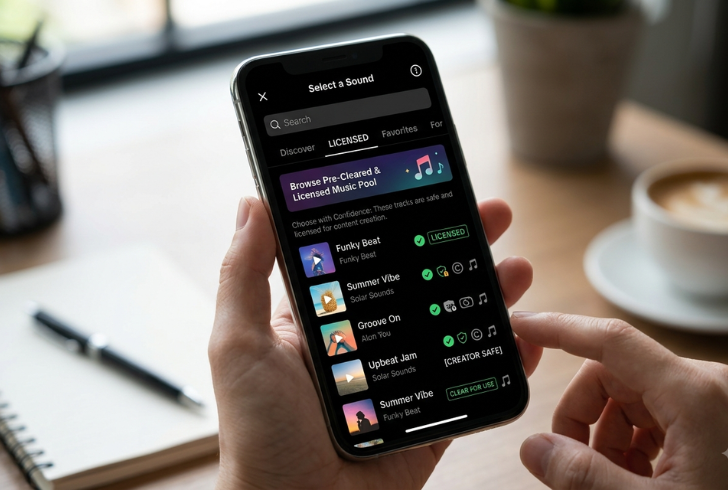
Gemini AI | TikTok offers easy access to music for personal videos, but usage rights are strictly limited to the platform.
TikTok creators generally have three broad choices.
TikTok’s General Music Library provides convenient access to many tracks for eligible personal content. The main limitation is that the permission stays tied to TikTok and the applicable terms.
The Commercial Music Library serves business accounts that need music cleared for promotional use on TikTok. Its catalog is more limited than the general library because commercial rights involve different licensing requirements.
Independent music libraries provide another option. Depending on the license, they can offer longer tracks and broader platform coverage. They can also make sense for branded content that needs to appear on several services.
No option eliminates the need to read the terms. A music service’s description may be brief, while the actual license contains the restrictions that determine how the track can be used.
What Creators Should Remember
The most useful distinction is between copyright law and platform licensing.
Copyright law does not create a universal 10-second, 30-second, or 60-second permission for songs. TikTok’s commonly cited 60-second allowance comes from its music licensing arrangements and applies to eligible music used under the platform’s conditions.
A few points make the rules easier to understand:
1. A short clip is not automatically copyright-free.
2. The 10-second and 30-second rules are not general legal exemptions.
3. TikTok’s in-app music permissions do not automatically cover Instagram or YouTube.
4. Business accounts have different music access because commercial content requires appropriate licensing.
5. Independently licensed music can provide broader rights, but the license must match the intended use.
6. Original music can still contain third-party rights if it includes another person’s composition, sample, or recording.
7. Keeping proof of music rights can help when a legitimate use gets flagged.
How to Use TikTok Music Safely
TikTok does not set a universal copyright exemption based on a song’s length. The commonly cited 60-second limit applies to eligible music used through TikTok’s in-app libraries under its licensing terms. It is a platform-specific permission, not a rule in U.S. copyright law.
Likewise, using 10 or 30 seconds of a copyrighted song does not automatically make the clip legal.
For personal accounts, selecting music from TikTok’s approved library is generally the simplest option. Business accounts have access to the Commercial Music Library, while creators who need longer tracks, commercial rights, or multi-platform use may need an independent music license.
Before publishing, check where the music comes from, whether the license covers the intended use, and which platforms will carry the video. A TikTok-approved track may not be cleared for Instagram or YouTube.
The key point: copyright protection does not depend on a specific number of seconds. The music’s licensing terms, intended use, account type, and distribution platforms determine whether the use is permitted.